
Word Problem Progress Monitoring in Special Education: A Complete Teacher Guide
What you'll learn in this guide
- Why word problem progress monitoring is different from regular classroom assessment — and why that distinction matters for IEP compliance
- Exactly how often to collect data based on goal intensity (with a practical frequency table)
- A step-by-step walkthrough of a complete monitoring session that takes fewer than 10 minutes
- How to present your word problem data at IEP meetings in a way that tells the full story
- The four data patterns that signal it's time to change your instructional approach
If you've ever sat down at an IEP meeting and realized your data folder for math word problems was … thinner than you'd like, you're not alone. Word problems sit in a tricky spot in special education: they're almost always part of a student's math IEP goal, yet they're among the hardest skills to monitor consistently because the data collection feels complicated and the materials are inconsistent.
This guide will change that. By the end, you'll have a clear system for word problem progress monitoring in special education — one you can actually sustain across a busy school year, not just the week before IEP meetings.
1. What Is Progress Monitoring and Why Does It Matter Specifically for Word Problems?
Progress monitoring is a systematic, ongoing process of collecting data on a student's performance relative to a specific goal. That last part — specific goal — is what separates progress monitoring from general classroom assessment.
When it comes to math, most special education teachers feel fairly comfortable monitoring computation skills. Flash a set of addition facts, count the number correct, plot the point on a graph. Done. Word problems, though? They're messier. A single word problem requires a student to read, decode meaning, identify the operation, set up the equation, compute, and check reasonableness. There are many places a student can succeed or stumble — and that complexity is exactly why consistent monitoring matters so much.
Here's the core reason word problem progress monitoring deserves its own focused system:
- Word problems reveal thinking, not just answers. A student who gets the right answer via a guess tells you something different than one who correctly identifies the question, circles the relevant numbers, and sets up the equation before computing.
- IEP goals for word problems are often multi-step. You need data that captures where in the process a student breaks down, not just whether the final answer was right or wrong.
- IDEA requires progress monitoring data tied to IEP goals. If a student's goal involves solving grade-level word problems, your data must directly measure that. General classwork grades do not qualify.
- Word problem skills don't always generalize. A student might master addition word problems in isolation but fall apart when mixed problem types appear. Monitoring catches this and keeps instruction targeted.
The bottom line: word problem progress monitoring is not optional overhead. It's the mechanism that proves your instruction is working — and protects you legally if it isn't.
2. Progress Monitoring vs. Regular Classroom Assessment — The Real Difference
This is where a lot of well-meaning teachers get tripped up at IEP meetings. Someone asks, "Do you have data on Marcus's word problem progress?" and you pull out a stack of completed worksheets with grades on them. That feels like data. But it isn't progress monitoring data — and here's why.
| Feature | Regular Classroom Assessment | Progress Monitoring |
|---|---|---|
| Purpose | Measure understanding of content taught | Track rate of growth toward a specific IEP goal |
| Frequency | After a lesson or unit (varies) | Consistent schedule — weekly, biweekly, or daily |
| Materials | Varies by unit, teacher, curriculum | Standardized probes — same format, same difficulty |
| What you measure | Mastery of new content | Rate of growth over time on a consistent measure |
| IEP compliance | Not sufficient alone | Required under IDEA |
| Decision rule | Reteach or move on | Continue, adjust, or change instructional approach |
The key word in progress monitoring is consistent. You need to use the same type of probe — same number of problems, same format, same difficulty level — every time you collect data. That consistency is what makes your data points comparable across sessions, which is what lets you draw a trendline and say, "This student is making adequate progress" or "This student is not making adequate progress, and here's what I'm doing about it."
The easiest way to ensure consistency is to use a structured problem set that stays the same in format across sessions — changing the numbers and context, but not the type of problem or the number of steps. A curriculum like the CUBES-based daily word problem bundles built specifically for this use case makes it simple.
3. How Often to Monitor Word Problem Progress
One of the most common questions special education teachers ask is simply: how often do I actually need to collect this data? The honest answer is that it depends on the intensity of the goal — but there are clear guidelines you can follow.
The chart below summarizes recommended frequency, and the table after it gives you the reasoning behind each category.
Recommended Monitoring Frequency by Goal Type
| Goal Type | Frequency | Rationale |
|---|---|---|
|
Intensive IEP goal (daily 1:1 or small group instruction) |
4x per week | High-intensity instruction requires frequent data to detect early response or non-response. Every session or every other session is appropriate. |
|
Active IEP goal (weekly small group, 2–3x/week) |
2x per week | IDEA requires reporting on IEP goal progress at least as often as general education grades are issued. Twice-weekly data gives you adequate points to detect a trend. |
|
Maintenance goal (skill achieved, monitoring for retention) |
1x per week | Maintenance requires spot-check data to confirm skills are holding. Weekly is usually sufficient; reduce to biweekly once three consecutive sessions show mastery. |
|
Annual review baseline (pre-IEP or annual assessment) |
Monthly | Used to establish current performance level or verify annual progress. Not a substitute for ongoing monitoring during the IEP year. |
If you're actively teaching toward a goal right now, you need at least two data points per week. If you're checking whether a mastered skill is holding, once a week is fine. If you're doing neither, ask yourself whether that goal belongs on the IEP at all.
4. What a Complete Progress Monitoring Session Looks Like
The good news: a properly structured progress monitoring session for word problems does not need to take more than 8–10 minutes. The key is having a consistent system so you're not making decisions on the fly each time. Here's a step-by-step walkthrough you can run today.
- Select your probe. Use the same format every time — for example, a set of three word problems at the student's goal difficulty level, using the same problem structure (e.g., one-step addition/subtraction, two-step mixed operations). The problems themselves should vary, but not the format or difficulty.
- Set the conditions. Same time of day when possible. Same support level — if the student uses a graphic organizer or strategy reference card during instruction, they may use it during monitoring too (just note this in your data). No additional teacher prompting or scaffolding beyond what you've already documented as standard.
- Administer the probe independently. Give the student the problem set and set a timer if your goal includes a fluency component. Otherwise, allow the student to work at their own pace. Do not guide their thinking — you're collecting a performance sample, not teaching.
- Score immediately. Score each problem using your rubric. At minimum: correct answer (1 point) and correct process (1 point). If your IEP goal references specific steps — like identifying the question, selecting the operation, and computing — score each step separately. This gives you diagnostic data, not just pass/fail.
- Record and plot the data point. Enter the score on your data sheet and add the point to your progress monitoring graph. A visual graph is not optional — it's the tool that makes the data meaningful. If you're not graphing, you're collecting data you can't easily use.
- Apply your decision rule. After every three to five data points, look at the trend. Is the student's data line above the goal line? Below it? Flat? This quick check — not a deep analysis, just a glance — tells you whether to stay the course or consider an instructional adjustment.
Notice that nowhere in those steps does it say "spend 20 minutes designing a new assessment." The probe is already built. The rubric is already set. The data sheet is ready. Your job is to administer, score, and plot — and structured curriculum materials make all three nearly automatic.

Grade 3 Fall Daily Word Problems with CUBES Strategy Bundle
Structured daily word problem sets built around the CUBES strategy — perfect for use as consistent progress monitoring probes. Same format every session, different problems. Everything you need to run monitoring without spending hours building materials.
View the Bundle →The Role of the CUBES Strategy in Progress Monitoring
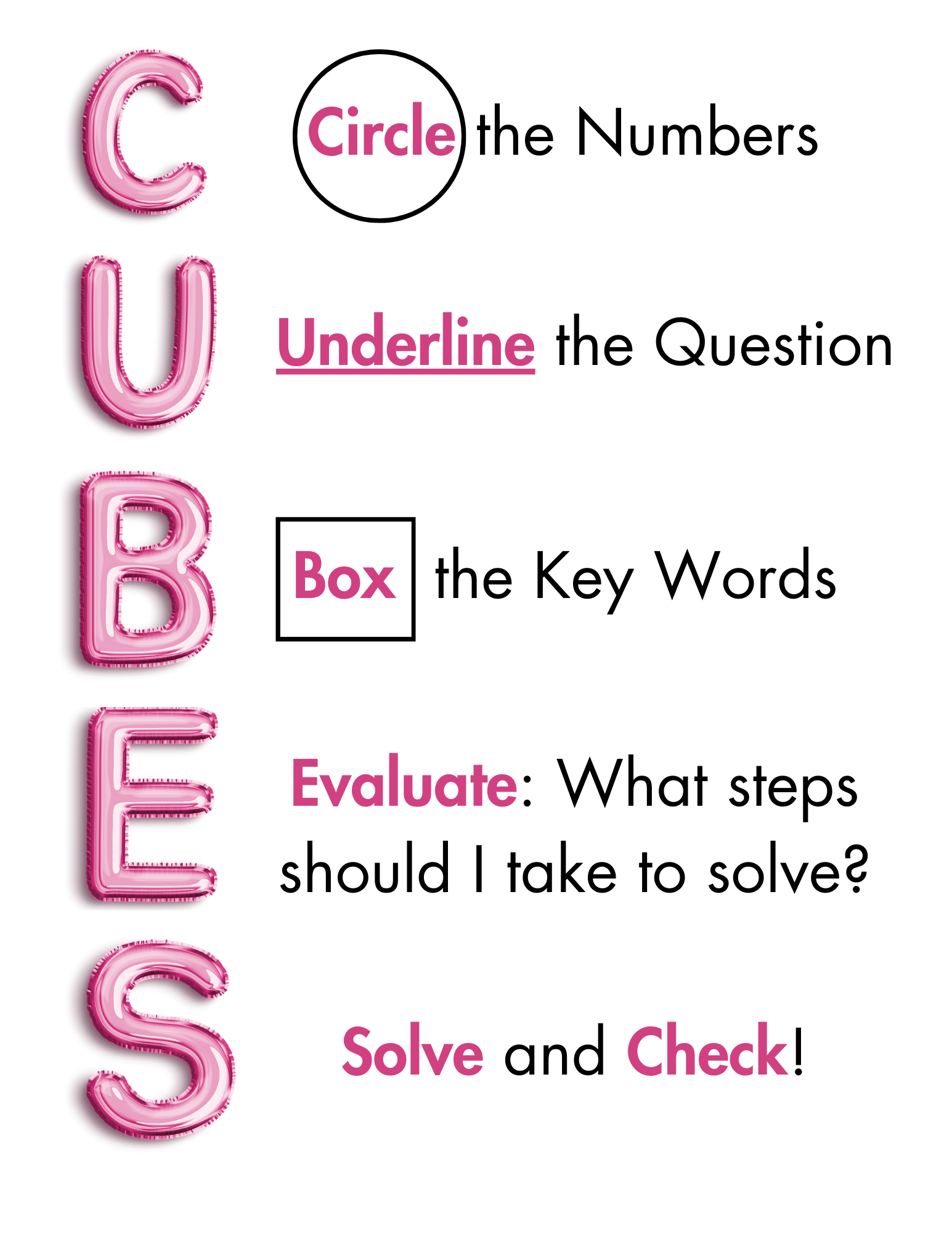
If your word problem instruction uses the CUBES strategy, you already have a built-in rubric framework. Each letter in CUBES represents a discrete step a student should complete when solving a word problem:
- C — Circle the numbers
- U — Underline the question
- B — Box the key words
- E — Evaluate and draw
- S — Solve and check
During a progress monitoring session, you can score each CUBES step separately — giving you up to five data points per problem. Over time, you'll see exactly which steps a student is mastering and which are still breaking down. That's the kind of granular, goal-aligned data that makes IEP meetings much easier to navigate.
Student Progress Monitoring Data Over 12 Sessions
5. How to Use Progress Monitoring Data at IEP Meetings
Collecting data is only half the job. The other half is presenting it clearly — to parents, administrators, and general education colleagues who may not share your comfort with progress monitoring graphs. Here's how to make your word problem data land the way it should.
Before the Meeting
- Print or display a visual graph. A line graph showing session-by-session performance against the goal trajectory is the most powerful tool in the room. It communicates in seconds what a data table takes minutes to explain.
- Calculate slope of improvement. Even a simple rate — "from September to January, Marcus improved from 40% to 72% accuracy on two-step word problems" — gives parents a concrete sense of growth.
- Prepare one or two work samples. Show an early session probe and a recent one side by side. Visual evidence of growth (or honest evidence of continued struggle) is far more persuasive than numbers alone.
- Know your decision before you walk in. Based on your data, is the current goal appropriate to continue? Does it need to be modified? Does it need more intensive support? Come in with a recommendation, not just a report.
During the Meeting
- Lead with the goal, then the data. "Marcus's goal is to solve two-step word problems with 80% accuracy by May. Here's where he is today." Keep the framing tied to the IEP document.
- Use plain language for trend descriptions. "Making adequate progress," "progressing below the expected rate," or "has met this goal and we recommend updating it" are clear, defensible, and parent-friendly.
- Note instructional changes in your data record. If you changed your approach at session 6, mark that on the graph. It shows you're being responsive — not just collecting data but using it.
- Tie next steps to data, not opinion. "Based on this trend, I recommend increasing monitoring frequency and adjusting the problem structure" is stronger than "I feel like he needs more support."
Parents often respond more positively to data than teachers expect. A clear graph that shows their child is making measurable progress — even if it's slower than peers — builds trust and collaboration. Data is not a weapon; it's a shared language.
6. Red Flags in Your Data: When to Change Your Approach
Progress monitoring only earns its keep if you act on what the data tells you. Here are four patterns to watch for — and what each one signals about your instructional next step.
- The student's data points cluster around the same score for four or more consecutive sessions with no upward movement.
- What it means: Current instruction is maintaining skills but not building them. The student is practicing but not progressing.
- What to do: Review whether the practice format is too easy (need more challenge), too hard (need more scaffolding), or simply not addressing the actual breakdown point. Shift your instructional focus or increase intensity.
- Scores drop across three or more consecutive sessions.
- What it means: Something has changed — either the task demands have increased, attention/fatigue is a factor, or the student hit a conceptual wall and is becoming avoidant or frustrated.
- What to do: Don't wait. Check in with the student about the experience of the sessions, review the error types in recent probes, and consider whether executive functioning is now a bigger factor than the math itself. (See our guide on executive functioning and word problem success for more on this.)
- Scores jump up and down dramatically from session to session — 85%, then 40%, then 80%, then 35%.
- What it means: The skill is not yet stable. The student may be guessing, or performance is heavily dependent on factors like time of day, anxiety, or how recently the skill was reviewed.
- What to do: Check your monitoring conditions first — are sessions happening under the same conditions each time? If conditions are consistent, the variability is real and signals that generalization has not occurred. Build in more distributed practice across different contexts and problem types before declaring mastery.
- The student's data line is consistently 10–15 points above the target trajectory from the first few sessions onward.
- What it means: The goal may have been set too low. This is a positive problem, but it's still a problem — a student achieving a goal in October when it was written for May isn't being adequately challenged.
- What to do: Celebrate the achievement, then update the goal. A student who has met an IEP goal before the annual date deserves a more ambitious target, not 7 more months of practicing something they've mastered.
All four of these patterns have one thing in common: you can only see them if you're graphing your data consistently. That's the whole point of the system.
Tools Built for Consistent Progress Monitoring
The single biggest barrier to consistent word problem progress monitoring is not knowing what to use as a probe. When your materials are inconsistent — different formats, different difficulty levels, different structures — your data can't be compared across sessions. These CUBES-based bundles solve that problem at every grade level.


MEGA BUNDLE: Full Year Word Problems — Grades 1–4
Everything you need to run a full year of consistent, CUBES-based word problem progress monitoring across all four grade levels. Structured probes, predictable formats, and built-in scaffolding — designed from the ground up for special education settings.
Get the MEGA Bundle →Frequently Asked Questions
Can I use the same progress monitoring probe I used last week?
No — you should not use the exact same problems repeatedly, because familiarity with specific problems inflates scores and gives you data on memory, not skill. The right approach is to use the same format (same number of problems, same type, same difficulty level) with different problem content each session. That's why structured curriculum sets with multiple daily problems are so useful for monitoring purposes.
What if my student refuses to engage during a monitoring session?
Note the refusal as a data point — it's information. If it happens once, consider the context (time of day, antecedent events, anxiety about performance) and try again. If it's happening consistently, the refusal itself is telling you something important: the task may be perceived as too hard, the student may be experiencing testing anxiety around math, or there may be an executive functioning barrier worth investigating. Document, don't just skip.
How do I handle accommodations during progress monitoring?
Use the same accommodations that are in place during instruction. If a student uses a multiplication chart during math instruction, they may use it during monitoring. If a student has extended time as an IEP accommodation, apply it. What you cannot do is provide new prompts or scaffold the problem in ways you don't do during regular sessions — that changes what you're measuring. Document all accommodations used on your data sheet so your records are complete.
Do I need to graph my data, or is a data table enough?
You need a graph. A data table tells you what scores a student earned; a graph tells you whether those scores represent a meaningful trend. The human brain is not designed to identify patterns in a column of numbers at a glance — but it reads a line graph correctly and immediately. For legal defensibility, clear communication with parents, and your own ability to make instructional decisions quickly, graph your data every time.
What counts as mastery for a word problem IEP goal?
Mastery criteria should be written into the IEP goal itself — something like "80% accuracy across three consecutive sessions" or "4 out of 5 problems correct over three consecutive data collection periods." If your current goal doesn't specify mastery criteria, that's worth addressing at the next IEP meeting. Without clear mastery criteria, you can't determine when a goal has been met — and that creates problems both legally and instructionally.
How is progress monitoring different from curriculum-based measurement (CBM)?
Curriculum-based measurement is one type of progress monitoring — specifically, a standardized, research-validated approach that uses brief, timed probes to measure academic growth. Not all progress monitoring is CBM, but CBM is always a form of progress monitoring. For word problems in special education, you don't necessarily need a formal CBM tool — you need probes that are consistent in format, scored with a clear rubric, and administered on a regular schedule. A structured word problem curriculum like the CUBES bundles can serve this function effectively when used systematically.
My student has mastered one problem type but not others. How do I monitor that?
Track them separately. If your IEP goal specifies "mixed operation word problems," your probes should include mixed types — but you can score and graph by problem type to identify specific patterns. Many teachers find it useful to run one primary monitoring measure (the goal-level skill) and one diagnostic measure (the specific breakdown point) in parallel. Your primary graph goes in the IEP file; the diagnostic data guides your daily instruction.
Your progress monitoring system in four steps
- Use structured, consistent probes — same format, different problems — every monitoring session
- Collect data at the right frequency for each goal: intensive goals need 4x/week, active goals need 2x/week
- Graph every data point and apply a decision rule after every 3–5 sessions
- Bring visual data to IEP meetings and tie every recommendation to a specific pattern in your graph
Word problem progress monitoring in special education doesn't have to be the part of your job that keeps you up at night. With the right materials and a simple, repeatable system, you can collect data that is legally defensible, instructionally useful, and genuinely reflective of your students' growth — in under 10 minutes a session.
The hardest part is just getting started. Pick one student, one goal, and one consistent probe. Run it three times this week. Graph the points. You'll have more useful information about that student's math trajectory than you've had all semester.