

IEP Math Goals for Word Problems: Examples, Benchmarks & Data Notes
Word problems are one of the most common areas where students with IEPs get stuck — and one of the most under-specified areas in the goals teachers write for them. A goal that says "the student will improve math skills" tells you almost nothing about what to teach, how to measure it, or when a student has actually made progress.
This post is about writing IEP math goals for word problems that actually hold up: goals that are measurable, broken into meaningful benchmarks, and connected to the data you collect every week. Whether you're working with a first grader solving single-step addition problems or a fourth grader wrestling with multi-step word problems, the structure stays the same — only the numbers and expectations change.
What You'll Find in This Post
- Why word problem IEP goals need to be process-focused, not just accuracy-based
- The five components every measurable word problem goal needs
- Ready-to-use goal examples for grades 1 through 4
- How to write benchmarks that show real progress over the year
- How to connect your goal directly to your data collection system
- Answers to the most common questions teachers ask about these goals
Why IEP Math Goals for Word Problems Need to Be Specific
Here's a goal that shows up on a lot of IEPs: "The student will demonstrate improved ability to solve math word problems with 80% accuracy by the end of the IEP period."
It sounds fine. But ask yourself: improved from what? With what kind of support? Across what types of problems? Is 80% accuracy measured on a single trial or averaged across a week?
A vague goal like this creates three practical problems:
- You can't build a meaningful instructional plan around it
- Progress monitoring becomes a guessing game — did the student actually grow?
- It won't survive scrutiny in an IEP meeting when parents ask how you're measuring it
Word problems are also unique in what they demand from students. It's not just computation — it's reading comprehension, identifying relevant information, selecting the right operation, and checking reasonableness. A good IEP goal for word problems needs to reflect that complexity. That means being specific about the process, not just the answer.
What Makes an IEP Word Problem Goal Measurable
Before you look at any examples, it's worth building the framework. A measurable IEP math goal for word problems has five components. Miss any one of them and the goal gets fuzzy fast.
Condition
The setup: what materials, what supports, what setting. "Given a visual anchor chart and 3 single-step word problems..."
Student Name
Always name the student. It's an IEP, not a curriculum standard — the goal belongs to that child.
Skill
The specific behavior: identify the question, choose an operation, solve, label the answer. Be concrete.
Accuracy Criterion
The measurable threshold: "4 out of 5 problems" or "80% accuracy across 3 consecutive sessions."
Time Period
When will you measure? "By the end of the IEP period" or "within 36 weeks" keeps you accountable.
What Makes a Word Problem Goal Measurable?
When you look at that chart, you'll notice the two components that drop off most are Condition and Accuracy Criterion. Teachers typically name the student and identify the skill — but leave out exactly what materials or supports are in place, and how many times the student needs to hit the target before the goal is considered met.
Those two missing pieces matter a lot for word problems specifically, because the right scaffold (like the CUBES strategy) should be named in the goal itself if students are expected to use it.
IEP Goal Examples by Grade Level (1st–4th Grade)
These examples are written to be usable as starting points — not copy-paste finals. You'll still need to adjust the student's name, the specific numbers, and any modifications based on your student's present levels. Use these to get the structure right, then personalize.
1st Grade: Addition and Subtraction Word Problems
- Condition: picture supports + number line
- Skill: identify question, select operation, solve
- Criterion: 80% / 4 of 5 problems
- Time: 3 consecutive weekly probes
2nd Grade: Multi-Digit, Single-Step Problems
- Condition: CUBES anchor chart provided
- Skill: label information, identify operation, write number sentence
- Criterion: 75% / 3 of 4 problems
- Time: 3 consecutive sessions
3rd Grade: Multiplication and Division Word Problems
- Condition: visual strategy checklist
- Skill: identify question, underline numbers, circle clue word, compute
- Criterion: 80% / 4 of 5 problems
- Time: 4 consecutive weekly probes
4th Grade: Multi-Step Word Problems
- Condition: graphic organizer for multi-step problems
- Skill: identify both questions, complete steps in order, label answer
- Criterion: 75% / 3 of 4 problems
- Time: 3 consecutive weekly sessions

MEGA BUNDLE: Full Year Word Problems + CUBES Strategy (Grades 1–4)
One purchase covers all four grade levels — a full year of daily word problem practice with the CUBES strategy built in. Designed specifically for special education and resource room settings, with scaffolded supports that match the IEP goal examples above.
Shop the MEGA BUNDLE →How to Write Benchmarks for Word Problem IEP Goals
Benchmarks are the checkpoints between where a student starts and where your annual goal lands. For word problem goals, they're especially useful because the skills build on each other — you can't accurately monitor "multi-step problem solving" if you haven't confirmed the student can handle single-step first.
A practical benchmark structure for a word problem goal looks like this:
| Benchmark | Timing | Target Skill | Accuracy Criterion |
|---|---|---|---|
| Benchmark 1 | ~12 weeks | Identify the question and underline key numbers with prompting | 3 out of 5 problems, 2 consecutive sessions |
| Benchmark 2 | ~24 weeks | Select correct operation and write a number sentence independently | 3 out of 5 problems, 3 consecutive sessions |
| Benchmark 3 | ~32 weeks | Solve and label the final answer without visual prompts | 4 out of 5 problems, 3 consecutive sessions |
| Annual Goal | ~36 weeks | Full process: identify, plan, solve, label — independently | 4 out of 5 problems, 4 consecutive sessions |
A few things to notice about this structure:
- Each benchmark is progressively less scaffolded — the supports fade as the skill builds
- The accuracy criterion increases over time (from 3/5 to 4/5)
- The number of consecutive sessions required also increases — this reduces the chance of a lucky data point driving your decisions
- The benchmarks align to the sub-skills within the annual goal, not arbitrary percentages
One question that comes up: what if the student hits Benchmark 2 but struggles with Benchmark 1? Go back and check your baseline. Benchmark gaps often reveal that present levels weren't specific enough — which is useful information for the next IEP.
Benchmark Progression for a Word Problem IEP Goal
Fading Supports in Your Benchmarks
One of the most common mistakes in writing IEP word problem benchmarks is keeping the same level of support from Benchmark 1 to the annual goal. If your goal says "independently" but all your benchmarks say "with anchor chart provided," there's no bridge between where the student is and where you expect them to land.
Build the fade into your benchmarks explicitly:
- Benchmark 1: With full CUBES anchor chart visible
- Benchmark 2: With a simplified 3-step checklist only
- Benchmark 3: With student-created reference notes only
- Annual Goal: Independently, without visual supports


Connecting Your IEP Goal to Data Collection
An IEP goal is only as strong as the data you collect against it. The good news is that a well-written word problem goal already tells you exactly what to measure — you just need a consistent system for collecting it.
Here's how the five goal components map directly to your data collection decisions:
| Goal Component | Data Collection Decision It Drives |
|---|---|
| Condition | What supports are present during the probe? Never add extra support during a data session. |
| Skill | What are you scoring? The final answer only, or each step in the process? |
| Accuracy Criterion | Your mastery threshold — note exact scores, not just pass/fail. |
| Time Period | How often are you probing? Weekly is the minimum for most word problem goals. |
| Consecutive Sessions | Track session number in your data sheet so you can identify when the consecutive window starts. |
A quick practical note: for word problems specifically, score the process steps independently from the final answer when possible. A student who correctly identifies the question, underlines the numbers, and selects the right operation — but makes a computation error — is demonstrating meaningful growth that gets hidden if you only record "correct" or "incorrect" on the final answer.
A Simple Weekly Data Routine
The teachers who collect the most consistent data tend to have a fixed routine — not a perfect system, just a predictable one. Here's what that can look like for a word problem goal:
- Monday or Tuesday: administer the 4–5 problem probe under goal conditions
- Score each step separately (e.g., identified question, correct operation, correct computation, labeled answer)
- Record the total score and note any patterns (e.g., always misses the label, struggles with clue words)
- Thursday or Friday: short re-teach based on what the data showed
- Update your graph or tracking sheet at the end of the week
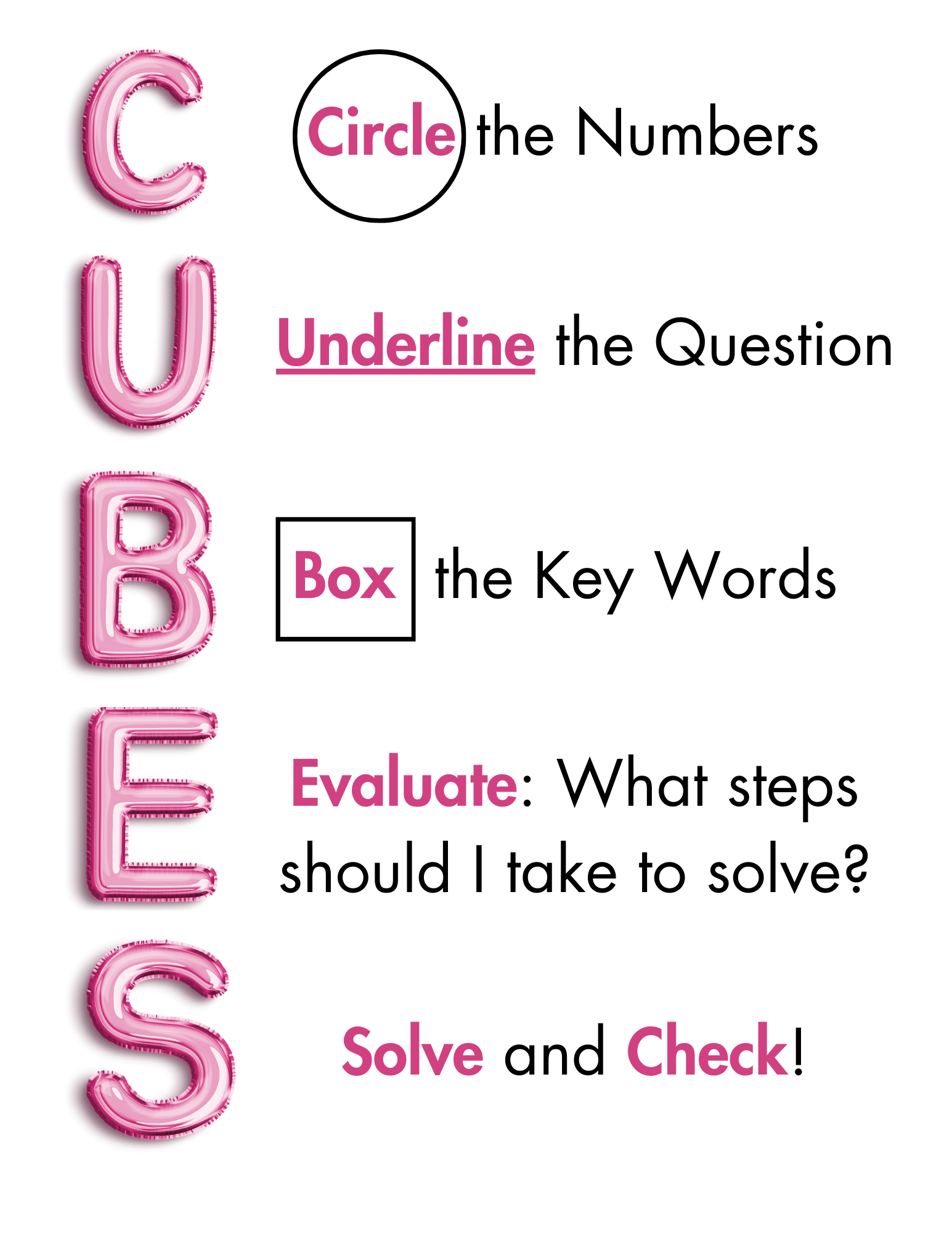
CUBES Word Problem Strategy Classroom Poster
A clear, print-ready reference poster for the CUBES strategy — designed for special education classrooms. Use it as the "with anchor chart provided" condition named in your IEP goal, then plan to fade it across benchmarks as students internalize the process.
Get the CUBES Poster ($1.99) →Frequently Asked Questions
Can I use the same word problem IEP goal template across multiple grade levels?
Yes — the structure stays the same, but you'll adjust the problem type, the numbers (e.g., within 20 for 1st grade vs. within 1,000 for 4th), the operations, and the number of steps. The five-component framework (condition, name, skill, criterion, time) applies at every grade. The most important customization is making the skill description match exactly what the student is working on right now, based on present levels.
Should I write a separate IEP goal for each type of word problem, or one goal that covers all of them?
In most cases, one well-written goal with clear parameters is better than several narrow goals that are hard to monitor consistently. If a student struggles with both multiplication and division word problems, you can write one goal that specifies "multiplication or division word problems" rather than two separate goals. Reserve separate goals for skills that truly require distinct instruction — like multi-step problems vs. single-step problems, which do call for different goal language because the skill set is genuinely different.
What's the difference between an IEP goal and an IEP benchmark for word problems?
The annual goal is where you expect the student to land at the end of the IEP period. Benchmarks are the measurable intermediate steps that track progress toward that goal. Think of benchmarks as the GPS waypoints — the annual goal is the destination. For word problems, benchmarks are especially useful because they let you measure the sub-skills (like identifying the question vs. selecting the operation) before the student has mastered the full process.
How do I know if my word problem goal is too hard or too easy?
Your present levels data should drive this. If you don't have a baseline probe — 4 or 5 word problems at the target grade level, given cold — collect one before writing the goal. A goal set at a student's current accuracy (e.g., they're already at 70% and the goal is 75%) won't drive enough growth. A goal set too far above present levels will leave you collecting data showing consistent failure. Aim for an accuracy criterion that requires real growth but is achievable within the IEP year with consistent instruction.
Do I need to mention the CUBES strategy specifically in the IEP goal?
You don't have to name a specific strategy in every goal, but if students are expected to use the CUBES strategy as part of their instruction, naming it in the condition helps. It makes the data collection conditions clear — you can specify "with CUBES anchor chart provided" at Benchmark 1, then fade that support in later benchmarks. It also protects you in an IEP meeting: if a parent asks what supports are in place, you have a specific answer.
Quick Recap: Writing Strong IEP Math Goals for Word Problems
- Every goal needs a condition, student name, specific skill, accuracy criterion, and time period
- Be specific about the process — not just whether the answer is right or wrong
- Match the problem type and numbers to the student's present grade-level access point
- Write benchmarks that fade supports progressively over the year
- Score process steps separately from final answers in your data collection
- Use a consistent weekly probe routine so your progress monitoring data is actually usable


