

Math Word Problem Accommodations for IEP Students: What to Use and How to Document Them
If you have ever sat down to write IEP accommodation pages and felt a quiet wave of uncertainty wash over you — you are not alone. Which accommodations actually help with word problems? How specific do they need to be? And once you start using them, how do you capture that in your data?
Here is the thing I wish someone had told me early in my career: accommodations are not a workaround or a shortcut. They are the bridge that lets a student demonstrate what they genuinely understand about math — without being stopped at the door by a barrier that has nothing to do with their mathematical ability. A student who struggles to decode text is not failing a math task. They are failing a reading task that is wearing a math costume.
Understanding word problem accommodations for IEP students — which ones work for which challenges, how to write them clearly, and how to document their use — is one of the highest-leverage skills a special education teacher can develop. This post walks you through all of it.
What You Will Learn
- The most effective accommodations organized by the type of challenge a student faces
- The critical difference between an accommodation and a modification — and why it matters for IEP writing
- How to document accommodation use inside your IEP data collection
- What strong accommodation notes actually look like
- Answers to the most common questions teachers ask
Why Word Problem Accommodations Matter More Than You Think
Word problems are not just math. They demand reading fluency, language processing, working memory, attention management, and organizational thinking — all before a student takes a single mathematical step. For students with IEPs, any one of those demands can become the place where learning breaks down.
This is why the accommodation conversation is so important. To learn more about the root causes at play, read our deep-dive on why students with reading disabilities struggle with word problems. Understanding the "why" behind the struggle is the first step to choosing the "what" of your support.
When accommodations are mismatched to the actual barrier, they either do not help or they create new confusion. The goal is precision: identify the barrier, then select the accommodation that directly addresses it.
Student Performance With and Without Accommodations
The Most Effective Word Problem Accommodations (Organized by Challenge Type)
Choosing an accommodation should start with one question: where is the breakdown happening for this student? Below are the four most common challenge profiles and the accommodations that research and practice support for each.
Reading Challenges
When a student's reading level is below grade level, decoding the word problem itself becomes the obstacle — not the math. These accommodations remove the reading barrier without reducing the mathematical expectation.
- Read-aloud by teacher or paraprofessional — The student hears the full problem spoken aloud, allowing them to focus all cognitive energy on the math.
- Text-to-speech software — Digital tools (such as Read&Write, NaturalReader, or built-in accessibility features) allow the student to independently access the text at their own pace.
- Simplified language version — The problem is rewritten at the student's reading level using shorter sentences, grade-appropriate vocabulary, and fewer embedded clauses — while keeping the mathematical structure identical.
- Vocabulary support — A glossary of math-specific terms (e.g., "altogether," "remaining," "in all") is provided alongside the problem.
- Highlighted key information — Numbers and operation signal words are pre-highlighted so the student's visual attention is guided to the relevant data.
Processing Challenges
Some students understand the math and can decode the text but need more time or reduced cognitive load to work accurately. Processing-related accommodations slow the pace without changing the content.
- Extended time — Commonly 1.5× or 2× the standard allotment. Specify the ratio in the IEP so there is no ambiguity during assessments.
- Chunked presentation — Multi-step problems are broken into numbered segments, presented one at a time so the student is not overwhelmed by the full visual of a complex problem.
- Reduced number of problems — The student completes a representative subset of problems (e.g., odd-numbered, or teacher-selected) that still measures the same skill.
- Frequent breaks — Short, structured breaks during longer math tasks reduce cognitive fatigue that compounds processing difficulties.
- Preferential seating — A low-distraction environment reduces the processing load from environmental stimuli.
Organization Challenges
For students who struggle with executive functioning — particularly planning, sequencing, and self-monitoring — the challenge is not reading the problem or knowing the math operation, but navigating the steps in order. Structural scaffolds are the right tool here.
- Graphic organizers — A structured template that prompts the student to identify what they know, what they need to find, which operation to use, and to show their work in an organized layout.
- CUBES strategy checklist — A step-by-step annotation strategy that builds a habit of active problem engagement. (More on this below.)
- Step-by-step problem-solving template — A fill-in frame that walks the student through each phase of the solution process with explicit labeled sections.
- Scrap paper / work-space accommodation — Explicit permission and structure for showing work so the student does not try to hold everything in working memory.
Memory Challenges
Working memory deficits are extremely common in students with learning disabilities and ADHD. When students cannot hold information in mind long enough to use it, their math accuracy drops dramatically even though their mathematical reasoning may be solid. Memory accommodations act as external working memory.
- Operation keyword reference sheet — A laminated card that lists signal words by operation (e.g., "total," "sum," "combined" = addition; "difference," "left over," "fewer" = subtraction).
- Calculation aids (number lines, hundreds charts, multiplication tables) — These do not reduce the math standard; they reduce the memory retrieval demand so the student can focus on problem-solving.
- Formula reference sheets — For geometry or measurement problems, a reference card with labeled formulas prevents the student from failing because of a memorization gap rather than a conceptual one.
- Anchor charts visible during instruction and assessment — Visual supports in the environment serve as passive memory prompts throughout the task.
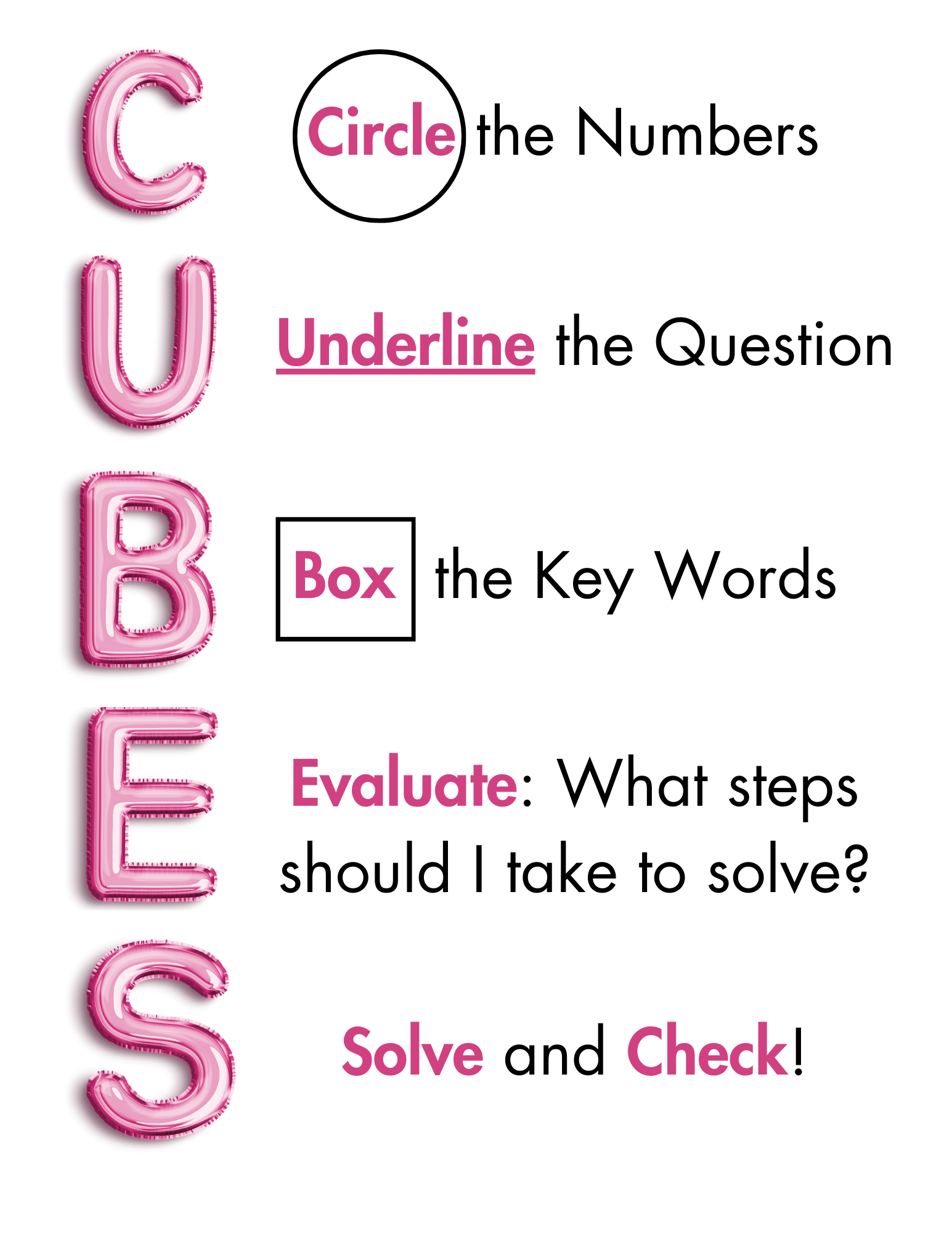
CUBES Strategy Poster — The Anchor Chart That Does the Work
Give every student a consistent, visual reminder of the CUBES problem-solving process. This poster serves as a permanent organizational accommodation that builds independence over time. Pair it with structured word problem practice for best results.
Get the CUBES Poster — $1.99For a deeper look at how to implement CUBES across your classroom, read our full guide on the CUBES strategy for special education. It covers how to introduce each step, how to fade the scaffold, and how to document student progress with it.
Most Common Word Problem Accommodations in SpEd Classrooms
Accommodation vs. Modification — The Critical Difference for IEP Writing
This distinction trips up even experienced teachers, and getting it wrong can have real consequences — for compliance, for student expectations, and for the signal your IEP sends to next year's teacher.
The core rule is this: an accommodation changes how a student accesses or demonstrates learning. A modification changes what a student is expected to learn or demonstrate. Both have a place in special education, but they mean very different things on an IEP.
Changes HOW
The standard, expectation, and content remain the same. Only the access method or presentation changes.
- Teacher reads problem aloud
- Student uses multiplication chart
- Problem presented one sentence at a time
- Extended time on test
- CUBES checklist provided
- Graphic organizer template
Changes WHAT
The grade-level standard, content, or performance expectation is changed. The student is working toward a different objective.
- Two-digit problems given instead of four-digit
- Single-step only (no multi-step required)
- Operation is pre-identified for the student
- Problems reduced to a lower grade level
- Answer choices provided (when not standard)
A Quick Litmus Test
Ask yourself: If I remove this support tomorrow, does the expectation for what the student must demonstrate change? If yes, it is likely a modification. If the expectation stays the same and only the access changes, it is an accommodation.
| Support Type | Changes Content? | Changes Standard? | Classification |
|---|---|---|---|
| Read-aloud for word problems | No | No | Accommodation |
| Multiplication reference sheet | No | No | Accommodation |
| CUBES checklist | No | No | Accommodation |
| Problems rewritten at lower grade level | Yes | Yes | Modification |
| Operation pre-identified for student | Partial | Yes | Modification |
| Extended time | No | No | Accommodation |
| Single-step only (grade requires multi-step) | Yes | Yes | Modification |
Structured Practice That Builds in the Accommodations
The best accommodation strategy pairs the right support with consistent, structured practice. These SER resources are designed with IEP students in mind — embedding the CUBES process, visual scaffolds, and grade-aligned content so the accommodation and the instruction reinforce each other.
How to Document Accommodation Use in Your IEP Data Collection
Here is where most teachers leave value on the table — and often do not realize it. Accommodation documentation is not just a compliance box. It is essential information for interpreting your data.
Think about it this way: if a student scores 8/10 on word problems one week and 4/10 the next, that shift means something very different depending on whether the read-aloud accommodation was used on the 8/10 trial. Without that notation, your data tells a story with a crucial piece missing.
For a comprehensive framework on building this into your regular practice, see our full guide on tracking data for word problems in IEP goals. It covers data sheets, frequency decisions, and how to organize information across multiple students.
The Four Things Every Accommodation Data Note Should Include
This level of specificity may feel like extra work at first, but it becomes fast once it is a habit — and it makes your annual review and re-evaluation conversations dramatically stronger. You will be able to show exactly what conditions produce progress for your student.
How to Track This Without Adding a Separate Form
The simplest approach: add a small "ACC" column to your existing data sheet. Code it with initials (RA = Read Aloud, GO = Graphic Organizer, ET = Extended Time, RS = Reference Sheet, CB = CUBES Checklist) and circle which ones were present for each trial. A key at the bottom of the sheet takes 30 seconds to create and makes the data instantly interpretable.
What Accommodation Notes Should Look Like in IEP Data
Vague data notes waste time and weaken your IEP. Here are examples of weak versus strong accommodation notation — the kind of specificity that makes re-evaluation reports write themselves.

MEGA BUNDLE: Full Year Word Problems with CUBES Strategy — Grades 1–4
Four complete grade levels. Every problem set built around the CUBES strategy with embedded scaffolds. Ideal for multi-grade resource rooms, intervention teams, and teachers who want one organized system they can use across their entire caseload — year after year.
View the MEGA BUNDLEFrequently Asked Questions
Do I need to document accommodation use every single data collection session?
Yes — and it does not have to be elaborate. A simple coded notation next to each trial (e.g., "RA, GO" for read-aloud and graphic organizer) is enough. The key is consistency. If you only note accommodations sometimes, your data becomes hard to interpret across sessions.
Can I use the same accommodation for all my IEP students who struggle with word problems?
You can use the same accommodation with multiple students, but the IEP rationale should always connect the specific accommodation to the specific student's barrier. A blanket "read-aloud for all students" policy is fine in practice, but each IEP should reflect that the accommodation was chosen intentionally for that student's disability-related need — not just applied uniformly.
What is the difference between an accommodation for instruction versus an accommodation for assessment?
Instructional accommodations are used during teaching and practice. Assessment accommodations are used during tests and formal measurement. Best practice is to align them closely — if a student uses a graphic organizer during instruction, they should generally be allowed to use it during assessment as well. Switching the supports between contexts undermines the validity of the data you collect.
Is using a multiplication chart during word problems a modification?
No — in most contexts it is an accommodation. If the IEP goal is word problem solving (not multiplication fact fluency), then providing a multiplication reference removes a memory barrier without changing the mathematical standard being measured. The exception would be if the goal itself involves demonstrating fact fluency from memory, in which case providing a chart would be a modification of that specific goal.
How specific do accommodations need to be in the IEP document?
Specific enough that a substitute teacher picking up your class could implement them correctly. "Extended time" is not specific enough — "extended time up to 1.5× the standard allotment for all math word problem tasks, both instructional and assessment" is. Vague accommodation language leads to inconsistent implementation, which undermines both student performance and your data reliability.
How do I know if an accommodation is working?
Compare performance data across sessions where the accommodation was used versus sessions where it was not (if any such data exists). Also look for qualitative indicators: Is the student engaging more actively? Completing more problems? Making fewer careless errors? Strong accommodation documentation — including the notation practices described above — makes this analysis possible. Without those notes, you are guessing.
Should I fade accommodations as students improve?
For strategy-based accommodations like CUBES or graphic organizers, fading is absolutely part of the goal — the aim is to internalize the process so the scaffold becomes unnecessary. For accommodations tied to a permanent barrier (such as a reading disability that will not resolve), fading may not be appropriate and the accommodation may remain throughout the student's program. Document the fading plan explicitly in the IEP if that is the intent.
The Bottom Line
Word problem accommodations for IEP students are not one-size-fits-all — and choosing the right one makes an enormous difference in what your data tells you, how your students experience math, and what your IEP documents actually show.
The teachers who feel most confident about their accommodation decisions are the ones who have done three things: connected each accommodation to the specific barrier it addresses, documented use consistently across every data session, and built structured practice into their instruction that embeds the same supports the IEP names.
That last piece is where the SER resources come in. When your practice materials and your IEP accommodations speak the same language — when CUBES on the classroom poster matches CUBES on the data sheet matches CUBES in the word problem packet — students experience consistency, and consistency is what builds independence.
You have got this. Your students are lucky to have a teacher who thinks this carefully about how to support them.


