

How to Use the CUBES Strategy for IEP Progress Monitoring
Most teachers use CUBES to help students solve word problems. But here is something I figured out after my second year in a self-contained classroom: CUBES is not just a problem-solving tool. When you use it consistently, it becomes a full data collection system — one that maps directly onto the skills written in your students' IEPs.
CUBES Strategy = Built-In IEP Data Structure
- Each CUBES letter represents a discrete, trackable skill you can write into an IEP goal or objective.
- Consistent use of the same steps every session makes your data reliable and defensible at IEP meetings.
- Prompting level (independent, verbal, gestural, physical) can be tracked per letter — not just per problem.
- Students who use CUBES consistently show dramatically faster growth than students solving word problems without structure.
- One monitoring sheet, five data points per problem — that is the CUBES difference.
Why CUBES Creates Built-In IEP Data Structure
Think about what most word problem IEP goals actually measure: accuracy on multi-step math problems, ability to identify key information, computation with grade-level numbers, or self-monitoring during problem-solving. Every single one of those skills has a home inside the CUBES framework.
When a student completes a CUBES problem, they are not just solving math. They are demonstrating — in five visible, documentable steps — exactly which sub-skills they have and which ones they still need support with. That is progress monitoring data. The strategy is the data collection tool.
If you are already doing the work of having students use CUBES, you are halfway to a complete monitoring system. You just need a consistent way to record what you are already observing. For a deeper look at the overall approach, check out our complete guide to the CUBES strategy as a foundation before layering in the monitoring structure described here.
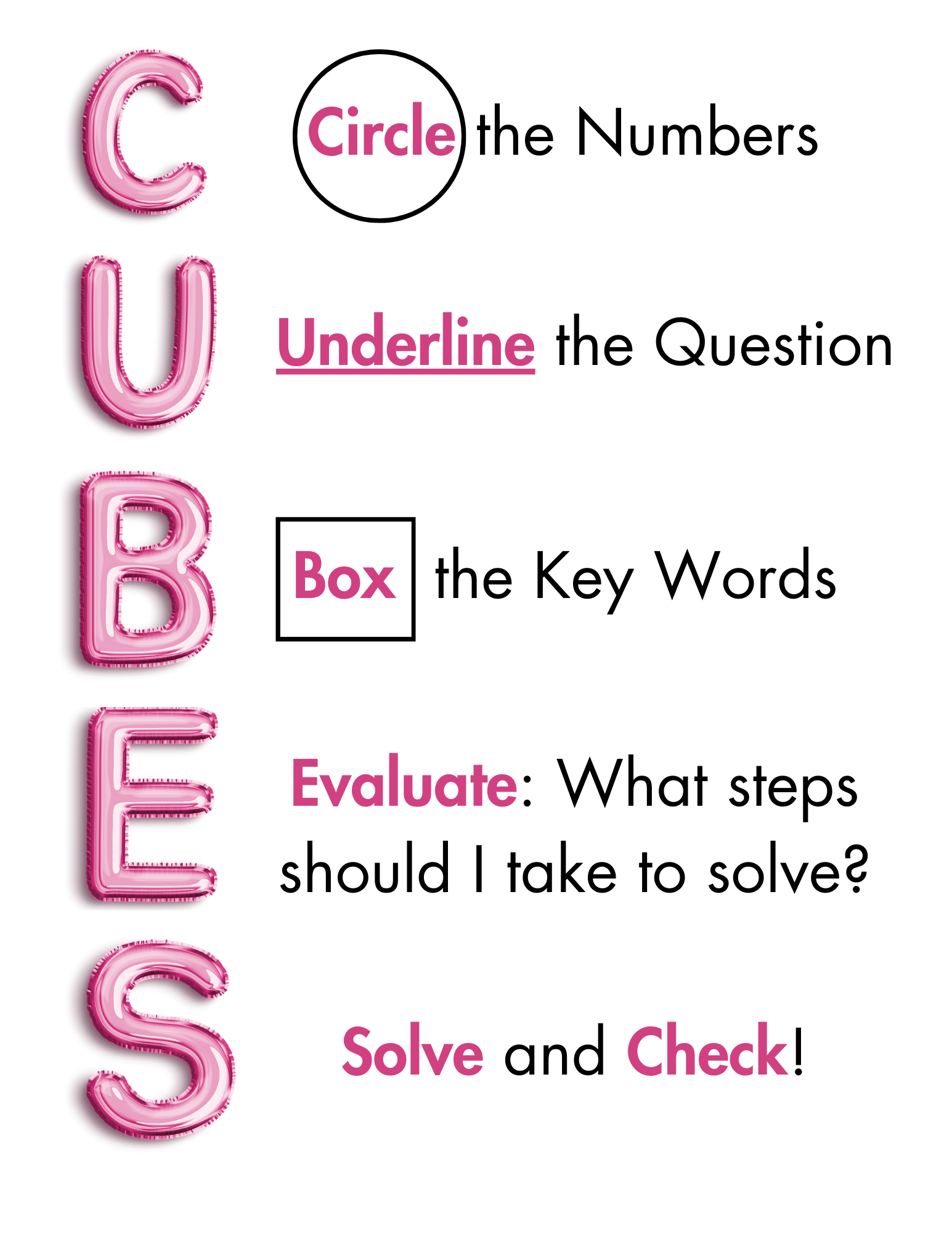
CUBES Strategy Classroom Poster
Keep every CUBES step visible during problem-solving and data collection sessions. This reference poster anchors the strategy for students and gives teachers a shared visual language for prompting.
Get the Poster – $1.99How Each CUBES Letter Maps to a Trackable IEP Skill
Here is the part that changed how I write math goals. Each letter in CUBES is not just a step — it is a skill domain. When a student struggles with a particular letter consistently, that tells you exactly what the instructional target should be, and how to write the next IEP objective.
Circles the Numbers → Number Identification Skill
IEP Skill: Number Recognition & ExtractionWhen a student circles all the numbers in a word problem, they are demonstrating number identification within a text context — not just on a number line or flashcard. This step also reveals whether a student impulsively circles irrelevant numbers (like a page number or date) or if they can accurately distinguish numerical information from narrative context.
Underlines the Question → Reading Comprehension of the Task
IEP Skill: Reading Comprehension / Task IdentificationUnderlining the question requires a student to distinguish between information that is given and information that is being asked for. This is a foundational comprehension skill that many students with learning disabilities or language processing differences struggle with significantly. A student who consistently underlines the wrong sentence is telling you something important about their reading comprehension level, not just their math skill.
Boxes Key Words → Vocabulary and Problem Decoding
IEP Skill: Math Vocabulary / Operational LanguageThis step is where math vocabulary becomes visible in your data. When a student boxes "altogether," "how many more," "each," or "total," they are showing whether they can identify the operational language that determines which math operation to use. Students who skip this step or box random words frequently are missing the connection between vocabulary and computation — a gap that will show up on every single word problem, regardless of grade level.
Eliminates Extra Info → Critical Thinking and Filtering
IEP Skill: Cognitive Filtering / Executive FunctionThe E step is the most cognitively demanding part of CUBES for many students with IEPs. Deciding what information is irrelevant requires holding the question in working memory, evaluating each piece of information against that question, and resisting the pull to use all available numbers. This is an executive function skill. Students who cannot complete the E step independently may need more support at the executive function level before they can master it in the math context.
Solve and Check → Computation Accuracy and Self-Monitoring
IEP Skill: Computation Accuracy / Self-MonitoringThe S step actually contains two separate data points: the accuracy of the computation itself, and whether the student checked their work. These are distinct skills and should be tracked separately whenever possible. A student can get the right answer without checking, or check their work but still arrive at an incorrect answer. Both of those scenarios tell you something different about where instruction should focus.
CUBES Letter Mastery Over Time
What CUBES-Aligned IEP Data Notes Look Like
One of the most common questions I get from special education teachers is: "What am I actually supposed to write down?" Here is the honest answer — you do not need a complicated form. You need five columns, one row per problem, and a consistent shorthand.
A simple CUBES monitoring sheet has columns for the date, the problem number, and each of the five letters (C, U, B, E, S). For each letter, you record the prompting level needed: I for independent, V for verbal prompt, G for gestural prompt, M for model, and P for physical assist. If the step was skipped or incorrect, note that too.
| Date | Problem | C – Circles | U – Underlines | B – Boxes | E – Eliminates | S – Solves |
|---|---|---|---|---|---|---|
| 5/6 | #1 | I | I | V | V | I ✓ |
| 5/6 | #2 | I | I | I | M | V ✗ |
| 5/9 | #1 | I | I | I | V | I ✓ |
| 5/9 | #2 | I | I | I | I | V ✓ |
That table above gives you five separate data points per problem instead of just one binary "correct/incorrect" at the end. Over four problems and two sessions, you can already see a clear trend: C and U are solidifying at independent level, B is catching up, E is still in the prompt phase, and S computation accuracy is inconsistent. That is actionable data.
For a comprehensive look at how to organize this data across multiple students and tie it back to IEP goal language, see our resource on tracking data for word problems in IEP goals.

Multi-Step Word Problems with CUBES Strategy Bundle — Grade 3
Structured practice sets designed for IEP progress monitoring. Each problem includes built-in CUBES scaffolding so students and teachers follow the same consistent steps session after session — the exact consistency you need for reliable data.
View Bundle – $15How Consistency in the Strategy Makes Data Reliable
Here is the thing about progress monitoring that does not get talked about enough: data is only meaningful if the conditions stay the same. If a student solves word problems using CUBES one day and without it the next, you cannot compare the results. The strategy is a variable, and if you change it between sessions, your data cannot tell you what is actually improving.
CUBES solves this problem by giving you a fixed procedure. Every session, every problem, the same five steps in the same order. That consistency is what transforms observations into data.
The consistency rule: If CUBES is in a student's IEP accommodation or instructional plan, it should be present in every monitored session — including those used to collect baseline data. Removing the strategy for a "cold probe" can undermine both student confidence and the validity of your comparison data.
-
✓Use the same physical materials. Whether it is a poster, a laminated card, or a reference strip on the desk, the visual prompt should look the same every session. This reduces visual processing demand and keeps student attention on the math.
-
✓Use the same verbal prompt language. If you say "What does the C step tell us to do?" in one session, say the same thing in the next. Standardized language gives you cleaner data — you can track whether the student responds to the specific prompt versus a different phrasing.
-
✓Record immediately, not from memory. Write down the prompting level for each CUBES letter during or right after the problem, not at the end of the session. Memory is an unreliable data recorder, especially across 30-minute sessions with multiple students.
-
✓Track problems of similar complexity. Progress monitoring data is most meaningful when the task difficulty stays controlled. Use the same problem type, operation, and number range across monitored sessions unless you are intentionally testing generalization.
-
✓Monitor at least twice per week. For students with IEPs, progress monitoring less than twice per week often does not generate enough data to show meaningful trend lines before the next IEP meeting. CUBES makes twice-weekly data collection fast because the structure is already in place.
Sessions Using CUBES vs. Not Using CUBES
Connecting CUBES Use to Prompting Levels
Prompting levels are already part of most IEP language, especially in special education settings. "Student will complete X with minimal verbal prompting" or "given gestural support, student will identify..." These are standard IEP phrases. CUBES gives you a precise, step-level location to attach those prompting levels.
Instead of tracking prompting level for the whole problem — which collapses five different skills into one number — you can track it per letter. A student might be fully independent on C and U, require a verbal prompt for B, and still need a model for E. That granularity is exactly what good IEP data looks like.
Independent (I)
Student completes the CUBES step correctly without any teacher input. No verbal, gestural, or physical support. This is the target level for IEP mastery criteria.
Verbal Prompt (V)
Teacher provides a spoken reminder or question (e.g., "What does the B step say to do?"). Student then completes the step correctly. Most students reach this level within the first few weeks of consistent CUBES use.
Gestural Prompt (G)
Teacher points to the CUBES poster, taps the worksheet, or gestures toward the step without speaking. Student responds to the physical cue. Useful for students who are becoming more independent but still need environmental anchoring.
Model or Physical Assist (M/P)
Teacher demonstrates the step or physically guides the student through it. If a student frequently requires this level for the same CUBES letter across multiple sessions, that letter represents an active instructional target — not just a support need.
When you attach prompting levels to individual CUBES letters across sessions, you can show an IEP team a clear trajectory: "In September, the student required a model for the B step on 4 of 5 problems. By November, they completed B independently on 4 of 5 problems." That is measurable, documented progress — and CUBES is how you got it.

MEGA BUNDLE — Full Year Word Problems, Grades 1–4
Everything you need for a full year of CUBES-based word problem instruction and progress monitoring across grades 1 through 4. Consistent structure, consistent data, consistent growth — one bundle for your entire caseload.
Shop the MEGA BUNDLEFrequently Asked Questions
Can I use CUBES progress monitoring data in an IEP meeting?
Yes — and you should. CUBES progress monitoring data is among the most granular word problem data you can bring to an IEP meeting because it breaks performance down by sub-skill rather than just overall accuracy. When you can say "the student improved from requiring a verbal prompt on the B step 80% of the time to completing it independently 75% of the time," that is meaningful, measurable evidence of growth in a specific skill area.
Just make sure your data includes the date, the task conditions (problem type, number range), the specific CUBES letter tracked, and the prompting level used. Those four elements make your data defensible.
What if a student is resistant to the CUBES routine and skips steps?
Step-skipping is data in itself. If a student consistently skips the E step (eliminating extra information), that tells you the step either feels unnecessary to them or is too cognitively demanding to complete independently — both of which have different instructional responses.
For resistance to the routine overall, consider whether the materials are accessible (poster visible, reference card on the desk), whether the routine was introduced with enough explicit modeling, and whether the student understands the purpose of each step. Meaningless-feeling routines get skipped; meaningful ones get used.
How do I write an IEP goal that uses CUBES as the monitoring tool?
Here is a sample goal structure that works well: "Given a grade-level word problem, [student name] will independently complete all five steps of the CUBES strategy to solve the problem with 80% accuracy across 3 consecutive sessions." You can also write sub-goals for individual letters if a student has particular gaps — for example, "Given a word problem with one piece of extra information, [student] will independently identify and eliminate the irrelevant data (E step of CUBES) with 80% accuracy in 4 of 5 trials."
How many problems per session do I need to monitor?
For meaningful progress monitoring data, three to five problems per session is typically sufficient, as long as you are collecting data at least twice per week. Three problems gives you enough data points to see patterns without overwhelming the session time, and five problems gives you a strong enough sample to calculate meaningful percentages. Fewer than three problems per session often does not generate enough data to show a reliable trend over time.
Should I track CUBES data differently for students who are still learning the strategy?
In the first two to three weeks of CUBES instruction, your data will mostly reflect the learning curve rather than baseline skill level. That is okay and expected — but it means you should not use those early sessions as your official baseline data for IEP purposes. Collect two to three weeks of instructional data first, then begin your formal progress monitoring once the student has had enough exposure to the routine to demonstrate what they can and cannot do independently.
Can CUBES work for students who have difficulty with handwriting or physically marking the page?
Absolutely. The marking steps (circling, underlining, boxing) can be adapted in multiple ways: students can use highlighting tape or highlighting markers instead of pencil markings, point to elements rather than marking them, use dry-erase sleeves over printed problems, or have a teacher or paraprofessional do the physical marking while the student directs verbally. The goal is the cognitive process — identifying the information — not the physical act of marking. Document any accommodations used alongside the prompting level in your monitoring notes.


